Mixing Strategy:
How grouping inputs produces a more balanced mix
Intro
There are many ways to achieve a final mix in a live situation, and I don’t know that one way is better than another. This is the way I prefer. That is why I like the term strategy. Similar to the game of chess, there are various strategies in mixing, each with its own advantages in achieving the desired outcome. In chess, the desired end is victory. In mixing, the desired end is a balanced mix.
Let me be clear: I can’t take credit for creating this strategy. I copied it from a video made by Dave Rat describing pretty much exactly the same strategy. It is a strategy that has given me the best results so far. Anyway, I have some things I want to say about it.
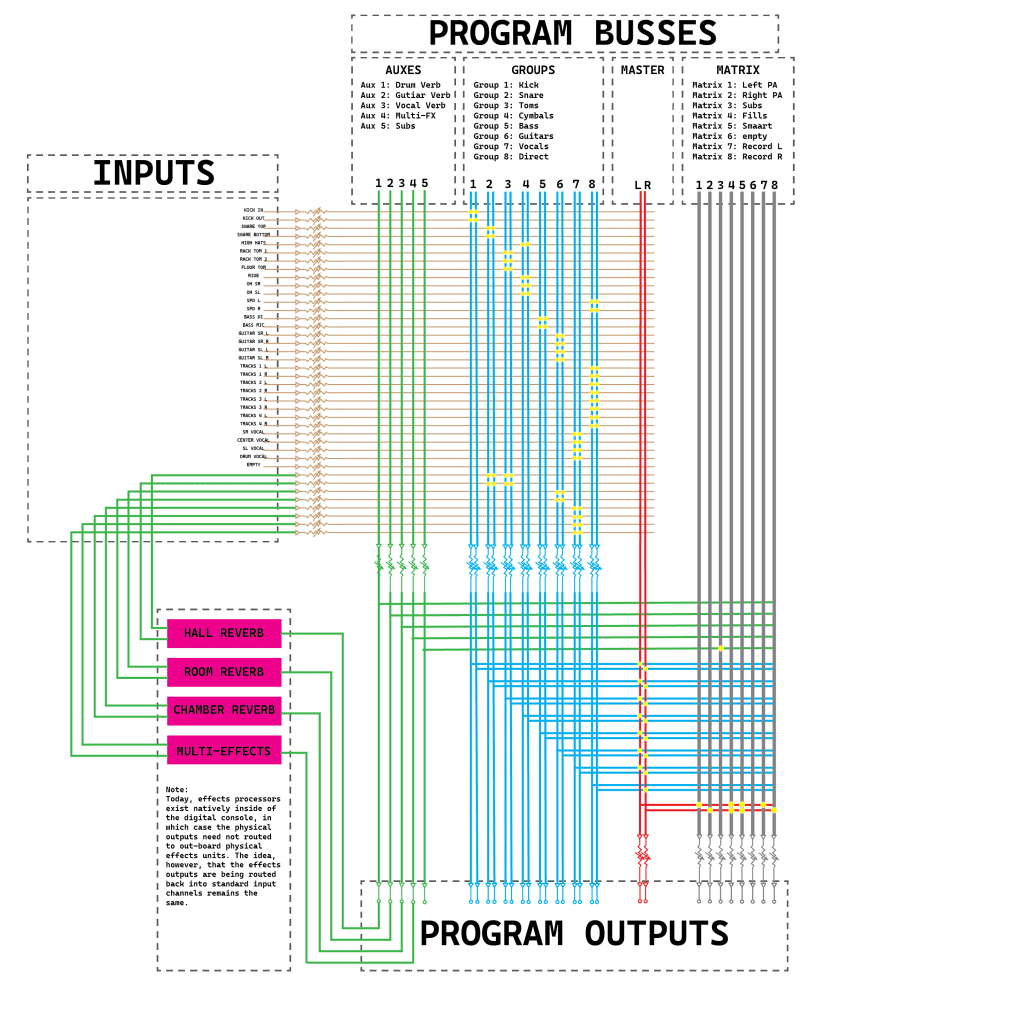
The diagram below illustrates a scenario in which a band is composed of a drummer with 5 piece kit, an electric bass player, a singer/electric guitarist, and another electric guitarist. In addition to this instrumentation there are several inputs of tracks to mixed in with the band. Again, this is a made-up input list to illustrate essentially how the mixing strategy works. The principle idea of the strategy is: to route no inputs to the LR master buss, but to route inputs to logical subgroups that are then routed to the LR master buss.
 Kolit Asdo